

Balance Disorder & Chronic Dizziness Neuro Chiropractor in Melbourne
Find out why you feel unsteady, dizzy or not like yourself, starting with a full neurological assessment
No GP referral · Claim on private health · Free parking




Is this you?
- You feel wobbly, unsteady or like you're walking on a boat
- Dizziness that gets worse when you move your head or turn quickly
- Supermarkets, crowds or scrolling on your phone make you feel off
- You avoid walking in the dark or on uneven ground
- Brain fog and exhaustion from constantly trying to stay steady
- You've had tests, the Epley manoeuvre or exercises, but still don't feel right
If this sounds familiar, you're in the right place.

Balance is a brain problem, not just an ear problem
Staying balanced depends on your brain combining three streams of information at once: your inner ear (movement and position), your eyes (where you are in your surroundings) and your body (the position sense from your joints, muscles and neck).
When your brain can't combine these signals accurately, you feel unsteady, dizzy or disconnected, even if each system tests normally on its own. Your nervous system then works overtime to compensate, which is why balance problems so often come with brain fog, fatigue and anxiety about falling.
My approach looks at how all three systems work together, so your care targets where the breakdown is happening.

Why chose Dr Tony Briggs Neuro Chiropractor to help with Vestibular migraines and Headaches
- 37+ years Clinical Experience
- Holistic Chiropractor
- Functional Neuro Rehabilitation Chiropractor (FNOR)
- Certified Lifestyle Medicine Professional
- Critical Care Nurse
- Member of the Australian Chiropractic Association
How my Brain First Approach™ works for balance disorders
I assess your inner ear, eye movements, body position sense and upper neck together, because balance problems are rarely caused by one system alone.
Your care may then combine:
- My Balance Reset Method™ to retrain how your brain combines signals from your inner ear, eyes and body
- Chiropractic care to improve movement and position input from your upper neck
- Medical laser therapy to help reduce pain and inflammation
- Personalised home exercises, graded to what your nervous system can handle, so you keep progressing between visits
I recheck your balance at every visit, so your plan adapts to how you're responding.

No guessing. A real assessment. A clear plan.
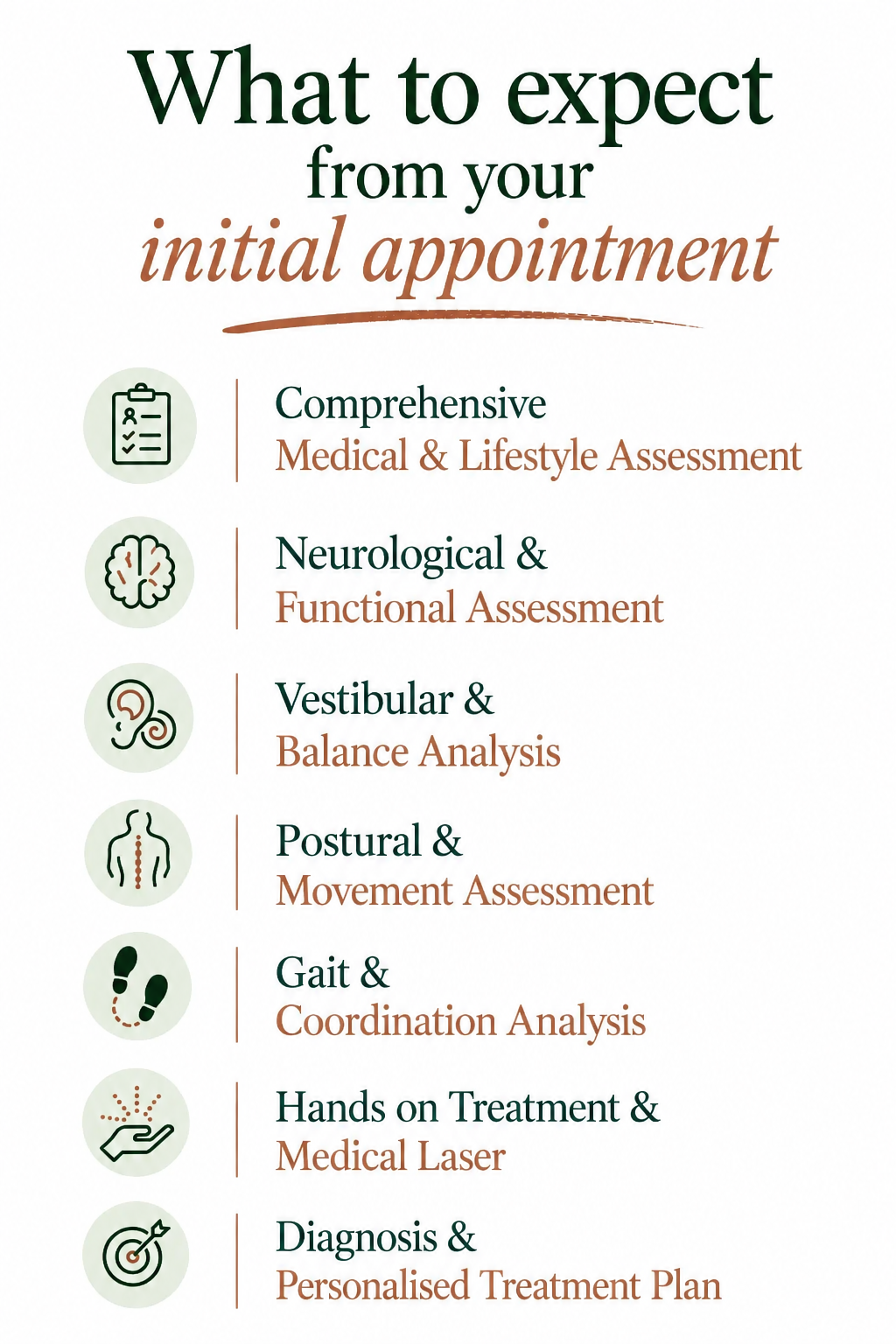
What to expect from your first Neuro Chiropractic Appointment
Your first appointment runs 60–75 minutes. I'll take time to understand your migraine history, your triggers, how often attacks happen and what you've already tried. Then I'll complete a full neurological assessment, which may include:
- Upper neck movement and posture assessment
- Eye movement and visual tracking tests
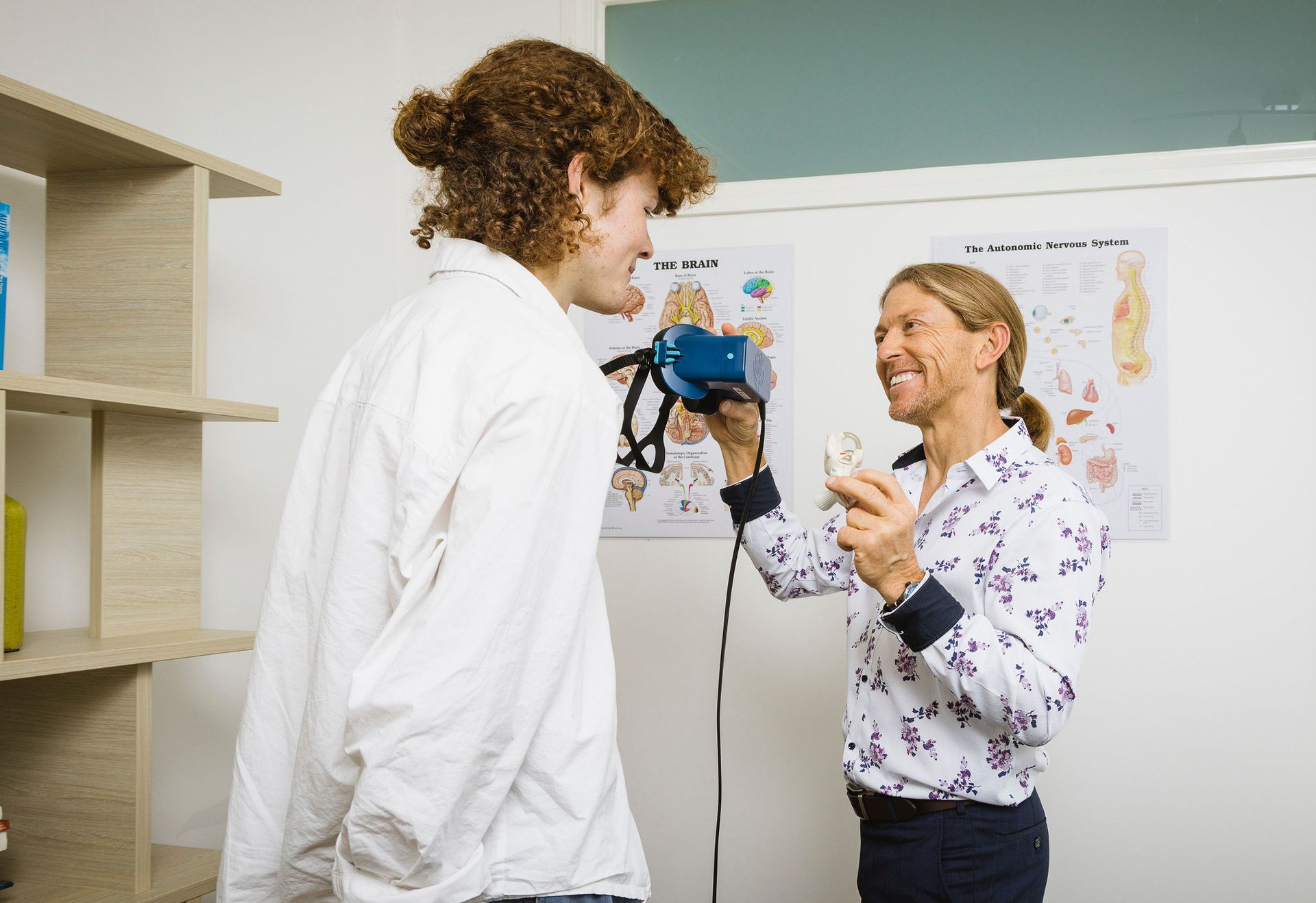
- Inner ear (vestibular) and balance testing
- A neurological screen, including reflexes and coordination
Everything is paced to how you're feeling. If light or movement testing starts to bring on symptoms, we slow down or take a break, and nothing is done without explaining it first.
You'll leave with a clear explanation of what I found, a personalised plan and a realistic idea of what to expect. Where appropriate, treatment can start the same day.
What to bring: A headache or migraine diary if you keep one, any scans or specialist letters, a list of your medications and comfortable clothing.
No guessing. A real assessment. A clear plan.
Benefits using Neuro Chiropractic and my Balance Reset Method for Balance Disorders
When your brain combines balance information more accurately, your nervous system has less to compensate for. Everyone responds differently.
With the right care, you may:
✓ Feel steadier on your feet
✓ Have less dizziness with head movement
✓ Cope better in supermarkets, crowds and busy places
✓ Walk with more confidence in the dark or on uneven ground
✓ Think more clearly, with less brain fog
✓ Have more energy through the day
✓ Feel less anxious about falling
✓ Get back to work, exercise, driving and the things you enjoy
Balance Disorders Symptoms
Balance disorders affect more than just your ability to stand still. They impact confidence, concentration, energy and your ability to move through daily life without fear. Common symptoms include:
- Unsteadiness and feeling off balance
- Dizziness and lightheadedness
- Vertigo and spinning sensations
- Difficulty walking in a straight line
- Tendency to veer or drift to one side
- Poor coordination and clumsiness
- Dizziness that worsens with head movement
- Visual disturbances and difficulty focusing
- Nausea
- Brain fog and poor concentration
- Fatigue and exhaustion
- Anxiety and fear of falling
- Symptoms worse in busy or visually complex environments
- Difficulty in the dark or on uneven surfaces
Balance Disorders treated by a Neuro Chiropractor
- PPPD (Persistent Postural Perceptual Dizziness)
- BPPV (Benign Paroxysmal Positional Vertigo)
- PCS (Post Concussion Syndrome)
- MdDB (Mal de Debarquement Syndrome)
- Vestibular neuritis
- Motion sickness
- Dizziness or Disequilibrium
- Vertigo
- Labyrinthitis
- MD (Ménière’s disease)
- Vestibulopathy
- VM (Vestibular migraine)
What Causes Balance Disorders
Balance depends on three systems working together in real time. Your inner ear detects movement and position. Your visual system tells your brain where you are in relation to your environment. Your proprioceptive system, the sensory network in your joints, muscles and spine, tells your brain where your body parts are in space. When the brain cannot accurately integrate all three signals at once, balance fails. You feel unsteady, dizzy when you move, uncertain on your feet or afraid of falling.
Balance disorders can develop from any disruption to these systems, individually or in combination:
- Inner ear dysfunction including BPPV, labyrinthitis and vestibular neuritis
- Upper cervical spine injury or dysfunction
- Concussion and traumatic brain injury
- Whiplash and neck trauma
- Viral illness and post-viral neurological changes
- Stroke and neurological conditions
- Ageing related changes in vestibular and proprioceptive function
- Neurological conditions including multiple sclerosis and Parkinson's disease
- Medications that affect vestibular or neurological function
- Anxiety and chronic nervous system dysregulation
In many cases no single clear cause is identified because standard testing assesses each system in isolation and misses the integration failure between them. A neurological assessment looks at all three systems together and identifies exactly where the breakdown is occurring. That is what makes targeted, lasting treatment possible.
FAQ Balance Disorders
Are you the right person to help with balance issues?
Balance disorders are among the core conditions I see. My Functional Neurology training gives me the tools to assess all three balance systems together — the inner ear, the visual system and the proprioceptive system — and identify exactly where the integration failure is occurring. If you have been told your tests are normal but you are still struggling with balance, dizziness or unsteadiness, I want to hear what has been happening. Call me directly before you book if you are unsure.
My tests came back normal. Why am I still unsteady?
Standard testing assesses each balance system individually. It does not assess how all three systems are integrating at the neurological level. A balance disorder can exist entirely within that integration failure. The inner ear, visual system and proprioceptive system each test normally in isolation, but the brain is not coordinating them accurately together. A normal test result with ongoing symptoms means the right assessment has not been done yet. A neurological assessment looks at the whole system simultaneously and identifies where the breakdown is actually occurring.
Is this chiropractic approach suitable if I feel easily overwhelmed or fatigued?
Yes. Care is carefully paced and adapted to individual tolerance. Sessions are designed to support regulation without pushing the system into overload or symptom flares.
It has been months since my concussion and I still have a balance problem. Is it too late to get better?
Definitely not. Balance issues are a part of Post Concussion Syndrome, and they respond well to targeted neurological rehabilitation regardless of how long symptoms have been present. The brain retains the ability to form new neurological pathways at any stage. The key is identifying exactly what was disrupted and retraining it directly. That is what I assess for and treat.
I have already had the Epley manoeuvre and vestibular physio. Why has my balance not improved?
It is because balance disorders are more complex than a single error pattern. The Epley manoeuvre is usually effective for BPPV specifically. Beyond this, vestibular physio typically improves compensation patterns, but does not, IMHO, address the root cause of the issues.
A persistent balance issue is a complex integration problem, hence neither of these approaches will resolve it.
That is why I ask different questions and seek to resolve the root cause of what is causing your issues.
Can I still have balance symptoms years after an accident, fall, infection or an assult?
Yes. This is more common than most people realise. A significant head impact, a severe inner ear infection or a fall that jars the upper cervical spine can all disrupt vestibular and neurological function in ways that do not resolve on their own. If the disruption was never properly identified and rehabilitated, the brain adapts to the dysfunction and symptoms become the new normal. Years later those same symptoms — dizziness, brain fog, headaches, balance problems — are still present because the underlying neurological dysfunction was never treated. It is not too late to address it.
Do I need to stop exercising or weight training if I start therapy for my balance issue?
Not at all. Caution is advised on the day of your first session, as you will need to get use to the 'software update'. After that, carefully graded activity is actually an important part of recovery. The key is matching the type and intensity of exercise to what your nervous system can tolerate at each stage. Pushing too hard too soon can worsen symptoms and delay recovery. I guide this process throughout your care so your activity levels progress safely alongside your neurological rehabilitation.
How long does it take for a balance issue to improve?
Your brain changes within seconds during the treatment session. However, this is not sustained because it is novel. that is why I give specific home movement patterns for you to do. This helps create long term change. Overall, complete recovery varies significantly between people. Some experience full recovery within a few sessions. Others, particularly those with post concussion syndrome or a history of multiple concussions, require longer and more structured neurological rehabilitation. In my experience, a minimum of 6 sessions is needed to achieve meaningful and lasting change. I will give you an honest timeline at your first appointment based on your specific neurological findings.
How many sessions will I need?
A minimum of 6 sessions is needed to achieve meaningful and lasting change. The exact number depends on how long you have had symptoms, the type and complexity of your balance disorder, and your overall neurological health. I will give you an honest and specific timeline at your first appointment. No locked in packages and no generic protocols.
Can Neuro Rehab help with PPPD or chronic dizziness?
Yes. Persistent Postural Perceptual Dizziness is a functional neurological condition in which the brain becomes sensitised to movement and sensory input following an initial trigger such as vestibular neuritis, a concussion or a period of intense stress. The vestibular system itself may have recovered but the brain has learned a pattern of dizziness and keeps running it. Targeted functional neurology rehabilitation addresses that learned neurological pattern directly, gradually desensitising the system and restoring accurate processing.
Can Neuro Rehab support brain fog or chronic fatigue associated with a balance issue?
Yes. Brain fog and fatigue after associated with balance issues and are neurological symptoms, not signs of laziness or deconditioning. They occur because the brain is working harder than normal to compensate for disrupted processing pathways. Targeted functional neurology rehabilitation reduces that neurological load by restoring accurate processing, which is why brain fog and fatigue often improve significantly as treatment progresses.
Do I need a formal balance diagnosis to start care?
No. Many people who come to see me have been experiencing balance problems, dizziness or unsteadiness for months or years without a clear diagnosis. If your symptoms are consistent with a balance disorder, a neurological assessment is the right starting point regardless of whether a formal diagnosis has been made. I will tell you exactly what I find.
Can I claim back on private health?
Yes, chiropractic care is covered by most extras policies including Medibank, BUPA, HCF, NIB and AHM. I process health fund claims on the spot. Rebate amounts vary by policy — worth checking with your fund before booking.
Is it safe to exercise with a balance disorder?
Yes, with the right guidance. Graded exercise and movement are an important part of balance rehabilitation. Complete rest allows the nervous system to maintain its compensatory patterns rather than correcting them. The key is matching the type and intensity of activity to what your nervous system can accurately process at each stage. I guide this throughout your care with take home exercises and neurological drills specific to your findings.
Can balance disorders develop after a viral illness?
Yes. Viral illnesses including COVID-19, glandular fever and inner ear infections can cause vestibular neuritis or labyrinthitis, which inflame and damage the vestibular nerve or inner ear structures. This disrupts the signals the brain receives from the inner ear and can result in persistent dizziness, unsteadiness and balance problems that do not resolve on their own. Post viral balance dysfunction responds well to targeted neurological and vestibular rehabilitation when the specific pathways involved are identified and treated directly.
Can balance disorders be caused by a neck injury or whiplash?
Yes. The upper cervical spine sends critical proprioceptive signals directly to the vestibular nuclei in the brainstem. When the neck is injured through whiplash, trauma or prolonged dysfunction, those signals become inaccurate. The brain receives conflicting information from the neck and the inner ear and cannot accurately determine where the body is in space. Cervicogenic dizziness and balance dysfunction is one of the most commonly missed diagnoses in people with persistent balance problems, particularly following a car accident or sports injury. It is a core part of what I assess for.
I've had MdBS for over 15 years, can I ever get better?
Yes. Mal de Debarquement Syndrome is one of the most debilitating and misunderstood balance conditions there is, and 15 years is a long time to have been living with it. But duration alone does not determine whether recovery is possible.
The brain retains neuroplasticity at any age and at any stage of a condition. What that means in practice is that the learned neurological pattern driving your MdDS can be recallibrated and retrained with an accurate stable reference. This is what I do on a daily basis with targeted Functional Neurology Neuro Rehabilitation.
Can a balance disorder be misdiagnosed as a mental health problem?
Yes, a balance (vestibular) disorder can be misdiagnosed as a mental health problem, such as anxiety or panic disorder. This is a very complex relationship.
When there is an error in your sense of where you are, that essentially results in your inner self feeling stressed and increasing cortisol and adrenaline just in case you need to escape from a situation. This may leave you feeling drained and fatigued, or 'wired and tired'. It can also explain long term anxiety.
Fixing the balance issues directly reduces anxiety and allows your body to begin to unwind. I treat many people with long histories of anxiety and depression and panic attacks. While these terms can be a sole diagnosis, all of the patients I see have had events or symptoms of a balance disorder before their medical diagnosis of mental health concerns.
Visit Dr. Tony Briggs for Neuro Rehab Chiropractic Care
Clinic Hours
Tuesday: 8 AM - 7 PM
Friday: 8 AM - 7 PM
Saturday: 9 AM - 1 PM
5 Beaumaris Parade, Highett, VIC, AUS
Free parking on site
Easy to reach from Brighton, Sandringham, Cheltenham, Mentone, Hampton and Moorabbin.
You don't have to plan your life around feeling unsteady. Let's find out what's driving it.